
Overview
I mostly work on imaging projects using optical interferometry. My main activities consist in improving image reconstruction algorithms, and then comparing the latest reconstructions (from CHARA, VLTI, NPOI data) with state-of-the-art astronomical modeling codes. This work is applicable to a very broad range of astronomical targets: AGN, giant convective stars, interacting binaries, magnetically spotted stars, young stellar disks, etc.

Young Stellar Disks
Protoplanetary disks around young stars are the birthplaces of planets. Using optical interferometry, we can resolve the inner regions of these disks at sub-AU scales, revealing disk structures, gaps, and asymmetries that may indicate ongoing planet formation. Can we detect planets in these stellar environments?
The Dynamic Inner Disk of a Planet-forming Star
Imaging the Inner Astronomical Unit of the Herbig Be Star HD 190073
A family portrait of disk inner rims around Herbig Ae/Be stars. Hunting for warps, rings, self shadowing, and misalignments in the inner astronomical units
Dusty disk winds at the sublimation rim of the highly inclined, low mass young stellar object SU Aurigae
Probing the Inner Disk Emission of the Herbig Ae Stars HD 163296 and HD 190073
A Multi-instrument and Multi-wavelength High Angular Resolution Study of MWC 614: Quantum Heated Particles Inside the Disk Cavity
Simultaneous Spectral Energy Distribution and Near-infrared Interferometry Modeling of HD 142666
Structure of Herbig AeBe disks at the milliarcsecond scale . A statistical survey in the H band using PIONIER-VLTI

Evolved Stars
Red supergiants, AGB stars, and hypergiants are massive stars in the late stages of their evolution. These stars exhibit dramatic phenomena including giant convection cells, mass loss events, and circumstellar dust formation. Our interferometric imaging reveals the evolving surface features and helps us understand the physics of stellar evolution.
An accreting dwarf star orbiting the S-type giant star π$^1$ Gru
A Spectroscopic and Interferometric Study of W Serpentis Stars. I. Circumbinary Outflow in the Interacting Binary W Serpentis
CHARA Near-infrared Imaging of the Yellow Hypergiant Star h̊o Cassiopeiae: Convection Cells and Circumstellar Envelope
Time Evolution Images of the Hypergiant RW Cephei during the Rebrightening Phase Following the Great Dimming
A new dimension in the variability of AGB stars: Convection patterns size changes with pulsation
An impressionist view of V Hydrae. When MATISSE paints asymmetric giant blobs
A long-term study of the magnetic field and activity in the M giant RZ Ari. Magnetism and planet engulfment in a fairly evolved star?
The Great Dimming of the Hypergiant Star RW Cephei: CHARA Array Images and Spectral Analysis

Binaries
Binary star systems provide unique opportunities to measure fundamental stellar properties like masses and radii. Interacting binaries like Algol and beta Lyrae show complex phenomena including mass transfer, accretion disks, and tidal distortions. Our imaging work produces movies of these dynamic systems.
An accreting dwarf star orbiting the S-type giant star π$^1$ Gru
A Spectroscopic and Interferometric Study of W Serpentis Stars. I. Circumbinary Outflow in the Interacting Binary W Serpentis
The Orbit and Dynamical Mass of Polaris: Observations with the CHARA Array
High-contrast, High-angular-resolution Optical Speckle Imaging: Uncovering Hidden Stellar Companions
Monitoring Spacecraft Materials Using Hyperspectral Speckle Imaging
A Benchtop Simulator for Evaluating Astronomical Observations with Object Generation and Point Spread Function Engineering
Establishing α Oph as a Prototype Rotator: Precision Orbit with New Keck, CHARA, and RV Observations
Multiplicity of Galactic Cepheids from long-baseline interferometry. IV. New detected companions from MIRC and PIONIER observations
Speckle Imaging
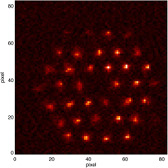
Speckle imaging techniques allow us to overcome atmospheric turbulence and achieve diffraction-limited resolution from ground-based telescopes. We develop advanced algorithms combining machine learning and physics-based approaches for wavefront sensing, hyperspectral imaging, and space domain awareness applications.
High-contrast, High-angular-resolution Optical Speckle Imaging: Uncovering Hidden Stellar Companions
Monitoring Spacecraft Materials Using Hyperspectral Speckle Imaging
A Benchtop Simulator for Evaluating Astronomical Observations with Object Generation and Point Spread Function Engineering
Designing a Representation Learning Method for Wavefront Estimation from Focal Plane Speckle Images
Physics Guided Machine Learning for Wavefront Sensing on a Hybrid Optical Telescope
Performance of an Imaging Shack-HartmannWavefront Sensor for Space Domain Awareness Observations
Hyper-Spectral Speckle Imaging of Resolved Targets
ARES: a versatile benchtop testbed for evaluating techniques for imaging through atmospheric turbulence